
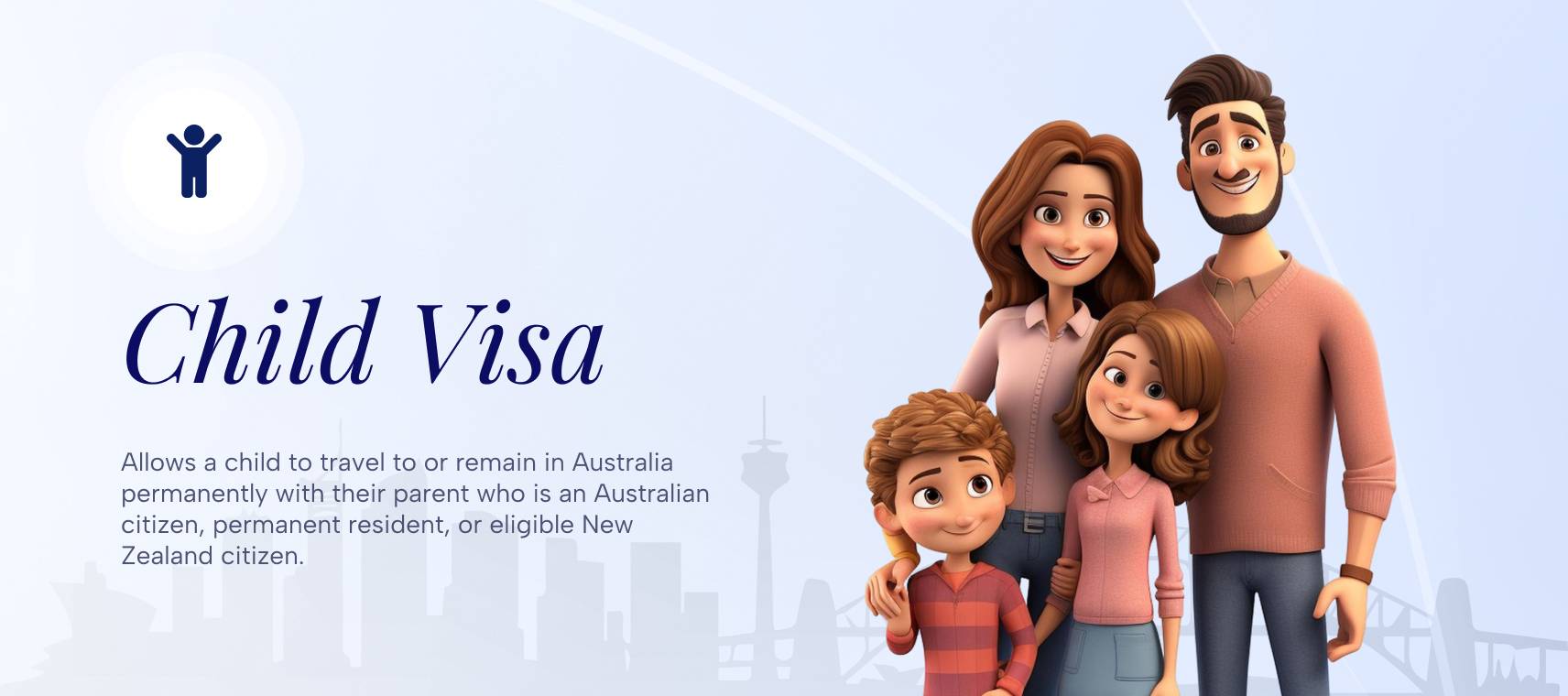
The child visa Australia allows the children to live with their parents in the country. The children become the permanent residents in Australia. The applicant of this visa should be a child of an Australian citizen or a permanent resident in the country.
For the children residing overseas, the parents or an eligible relative will sponsor the children for this visa. In case the child is adopted then also the adoptive parents can sponsor their child. The applicant or Child is eligible for this visa only if the child is 18 years of age and is supported by a parent. The child should be a student (full time).
The main type of primary visa for children is Subclass 101. But, for the children already living in Australia, there is Child visa 802.
The documentation required for a child visa Australia are:
It is important to establish the relationship of the child with the sponsor. It is important to know the child is a biological one or not.
The age of the child has to be less than 18 years.
In case of an adopted child, other necessary proofs that establish legal adoption will have to be produced.
Along with the child’s identity, the relationship between the parent and the child also needs to be established with the supporting evidence.
The passport or the citizenship proof of the parent is also necessary.
Sponsorship of the child is done by the parent or a legal guardian. Grandparents can also answer the child only in case if the child is an orphan.
Adopted children are also entitled to a child visa provided they are adoption is legally recognized in Australia.
In special cases, if the child suffers from a disability and is totally dependent upon the parent financially, then the age of the child can be above 18 years.
A copy of the child’s passport
Birth certificate
A family book or register
Police clearance certificate
Health examination certificate etc.
There are different types of child visas in Australia. You can opt for the visa category that suits your requirement depending upon your child’s circumstances. The types of child visas are;
If you feel that the various visa types are slightly confusing it is always advisable to consult the one of the best child visa agents Australia.

The child visa processing time varies depending upon the visa subclass that you have opted for.
There are a series of factors that processing time of child visa categories. These are:
However, in some cases form affairs may consider to expedite the process in case of urgency.
Child visas are of various types. The application process is as follows for all these types:
The eligibility criteria involve the following:
Sometimes, you may also need additional documentation financial dependency of the child on the parent .
Processing times vary by visa subclass. For example, Subclass 101 and 802 can take 6-12 months, while a Dependent Child Visa (Subclass 445) can be as quick as 1-2 months. The complexity of the case and the accuracy of the application can affect this.
The child must be under 18 years of age. In special cases, if the child has a disability and is financially dependent on the parent, they may be older than 18.
The child must be a child of an Australian citizen, a permanent resident, or an eligible New Zealand citizen. Generally, the child must be under 18 years of age.
Yes, the child (and sometimes the sponsor) will need to undergo a health examination and provide a police clearance certificate to meet health and character requirements. These should be arranged early in the process.
It is crucial to provide accurate information. If you notice an error after submission, you should update your application through your ImmiAccount as soon as possible to avoid delays or a potential refusal.


Skip the stress and complexity. Our experts handle the entire visa process, maximizing your approval chances and saving you valuable time.
 Higher Success Rate Priority Processing Dedicated Support



.png)
-compressed.jpg)
 (1).png)
.png)
.png)
 (1).png)
.png)


.png)
.png)



.jpg)
 (1).jpg)